Thursday, June 10, 2010

Reflections: the end of an assignment


Before this assignment I'd had some experience with blogging, but on a personal, 'diary entry' kind of level and never anything to a professional extent (or any extent that garnered me more than eight followers), and even then I gave up after thirty or so posts. One thing for sure is that frequent blogging is a dedicated hobby--and I use that word with caution. It is a form that actually requires a lot of patience and skill. I never would have thought before this project that I would spend multiple hours trying to get my header image edited just right in MS Paint, and actually feel satisfied when I almost got it! I guess that blogging is also an addictive hobby; the more recognition and the more likeminded followers you get, the harder it is to go back to real life where every sentence you wish to express isn't carefully composed, linked and edited before it's published.

Now to my opinion on the host itself: Blogger is a great tool for first time users who want to get something typed and see it published on screen, in one of the site's seven or so tasteless templates, within minutes. The composing and HTML features are probably as simplified as they could be, but when it comes to the visual layout and design aspects that's where the site has its downfalls. I became frustrated with, among other things, the fact that images could only be inserted in one of three sizes, in one of three places, and even then it took multiple 'publish post, view blog, edit post' back and forth's to get a paragraph looking decent. The colour schemes, fonts and lack of lowercase type sometimes proved problematic as well, but I am simply an arts and crafts girl who would prefer to cut and paste a design herself with scissors and glue (not right clicks of the mouse) than have to deal with garbled HTML code, so my personal opinion is in no way a reflection of the host tool itself.*

In closing, this assignment has been eye-opening and has taught me a lot about technology, design and online forms of publishing. I many even start up my personal blog again, but for the time being it will feel good to pick up a pen and paper again.

*NOTE: a few days after I published this post, Blogger released a new design section on its site which could have been very useful a few weeks earlier and probably renders my complaints irrelevant.

1 Image source
2 Image source

Wednesday, June 9, 2010

e-readers the future of publishing?


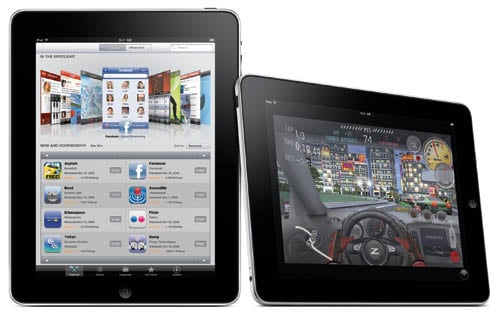
Amazon.com's handheld reading device, Kindle, started off as a niche product for the site to promote its downloadable content, but the e-reader technology it introduced may well be the future of publishing, with Apple's iPad being released this year and the Kobo eReader available at Borders stores around the globe as of this month.

The difference between e-readers and other gadgets--like the iPhone--which provide e-book applications, is that e-readers are designed primarily for the function of reading digital books. Their specific features usually include a long battery life, portability, readability of the screen in bright sunlight and many now use e-ink and e-paper; special display technology designed to give the appearance of ordinary ink on paper. This technology works through the use of a backlight which allows the screen to reflect natural light, like paper, instead of emitting its own light like a computer monitor, so reading is as natural as on real paper.

There are also many ways or purchasing e-books straight to these devices. The latest generation Kindle boasts a 'books in 60 seconds' feature which allows users to download books straight to the device with no fees, through either the device's 3G or wireless internet. It offers over 1.8 million free out-of-copyright books like Treasure Island and Pride and Prejudice. Prices for bes sellers and new releases also start from $9.99. Prices in Australia may seem a bit hefty for those who still know what a library is, but devices like these are designed for on-the-go people who don't want to be hassled by the thought or finding, or carrying around, the books they're after. For their niche market e-readers are ideal, and with this years surge of such devices, that market seems to be not so niche anymore.

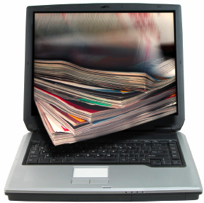
New, immediate forms of publishing like e-readers mean that the good old fashioned forms of print media are becoming less and less relevant today. Tangible aspects like the texture of the paper, typography used and the carefully designed cover art are no longer important aspects of book publishing; these features that used to define the term 'reading' are simply being pushed to one side for the ease of access and on-the-go nature of these wireless devices. Perhaps this is what all documents will become in the future-- not only does it make sense from a 'modern lifestyle' perspective but also from an environmentally friendly one-- however if print media one day does become extinct, chances are a lot of people will miss these aspects.

Image source

Tuesday, June 8, 2010

Print vs online design


Designing for the web is very different from designing for print, which is something that we don't tend to take into account when scanning through an easy-to-navigate site, but which is more apparent when viewing a headache-inducing mess like angelfire, the 'world's worst webpage'. Unlike any other era, many documents today will be designed for on-screen distribution only and will never be 'printed' in the traditional, commercial sense of the word. The only way many documents will make it onto paper is through as low-quality, desktop ink-jet printer, which largely influences many aspects of design.

According to Roger Parker, graphic designer and author of Looking good in print (2003), website distribution brings up several readability issues but basic rules that enhance printed documents are still applicable. Parker urges his readers to design for the worst case scenario--onscreen reading-- and lists three key differences between designing for print and online:
  1. Online reading is harder than reading from paper as the screen involves projected light and increases eye fatigue when compared to the contrast range of printed documents.
  2. A limited amount of text is visible at a time on screen, so readers are more likely to scan as it's harder for them to get a 'big picture' view of what they're reading. Seeing text in a continuous, scrollable flow onscreen can get overwhelming when compared to a printed document that gets tackled one page at a time
  3. You can never be sure which publication will be read on screen and which will be printed before reading so it's always best to create pages that can be comfortably read either way.
Some key ways to enhance onscreen readability are to build up white space around your text so as not to bombard the reader, avoid multiple columns when choosing layouts and to divide your text into manageable chunks through indicating paragraphs, using links, contrasting fonts and inserting frequent subheadings.

When designing for print there is much less emphasis on getting the audience to actually read the document, so key print design principles are usually more catered toward specific forms (brochures, newsletters, flyers, magazine articles, etc).In conclusion, oscreen reading is becoming more and more accepted, not only with the popularity of the web but also with the push for a more environmentally friendly way of reading. With some practice onscreen design can appear very pleasing and easy to read, but for some forms print will always be the original and the best.

Parker, R 2003, 'Designing documents for web distribution', Looking good in print, Paraglyph Press, Scottsdale, Ariz.

Image source

Monday, June 7, 2010

3D the technology of tomorrow?

According to a recent article television manufacturers are scrambling to bring 3D technology to homes after the enormous success of blockbuster Avatar last year. Bigwigs such as Sony, Panasonic, Samsung and LG are putting all their eggs in the 3D basket, with content producers also climbing on board. But the question remains whether consumers will be willing to upgrade --glasses and all-- so soon after the extensive adoption of HDTV.

James McQuivey, Forrester media analyst, says that television manufacturers are battling against the popularity of video on computers, mobile devices and new gadgets like the iPad. Their response has been to release internet-enabled sets allowing online connectivity and streaming, followed now by 3D TV. McQuivey says that it's the first time television has felt under threat-- hence the hefty push from largely invested companies like Sony and Panasonic, who both also make 3D cameras and editing suites.

The technology is still a long way off from being realistically available to every television owner, with current prices above $3,000 and no sets available without the expensive glasses. Leading brands are however predicted to get competitive with selling, and once the technology is absolute the prices could fall as fast as those for internet-enabled sets.

If television manufacturers have their way, it would seem that the tacky add-on of cinema from the past will become the next big leap in modern entertainment. Who would have thought it back in the 80s? Probably everyone.

Image source

Thursday, June 3, 2010

iPad a sure bet?


According to a recent article by Lara Sinclair, The Australian newspaper is said to be the first in the country to sign up for the iPad's lucrative advertising packages. The app will be launch when the iPad goes on sale in May and The Commonwealth Bank, as well as two other companies, has already signed up for the same package.

Each advertising package is said to cost $250,000 with $50,000 of that price paying for the iPad format alone--a hefty sum considering the audience will start from zero at the launch. A full-page colour ad in the weekday edition of The Australian costs $43,000, a small figure in comparison, but News Limited national sales director Tony Kendall and The Australian’s deputy chief executive Nick Leeder both believe the company’s splurge is justified, saying that ‘there’s a lot of interest based on the fact the technology’s hot’, and, ‘it’s a bit like the Superbowl. You’re really interested to see the ads’.

Improved functionality, such as embedded links, videos and advertising within individual stories is rumoured to be available later this year on the iPad, while at launch the format of ads is so new that it doesn’t even have a name yet.

It would appear that no matter what new technology it brings out, Apple is a large and trusted enough brand to gain the investment and support of huge companies before there are even any sales forecasts. One safe bet is that Apple is here to stay.

Image source

Sunday, May 30, 2010

Facebook privacy bungle

Facebook founder Mark Zuckerberg finally gave in to pressure from critics this week and announced plans to update the site's privacy settings. In Lanai Vasek's article, published in The Australian on May 24th, it was reported that Mr Zuckerberg announced the plans by exchanging an email with popular technology blogger Robert Scoble who soon shared it on his website, apparently with Zuckerberg's permission. The announcement came little over a week after a Sydney teenager was allegedly murdered by a man who had befriended her on the site, with Zuckerberg stating: 'I know we've made a bunch of mistakes, but my hope at the end of this is that the service ends up in a better place and that people understand that ...we respond to the feedback from the people we serve'.

With Facebook continuing to grow and expand it has come under fire from privacy and consumer groups over its fancy new features, most recently the ability to share data with Twitter, which compromise the privacy of its 400 Million+ members. These features basically make personal information available to third-party websites, and, according to user surveys, the site's current 5 830 word privacy policy isn't making that clear enough. Facebook said it would now move to make its personal information settings 'simpler and easier to use.'

May 31st has been declared Quit Facebook Day and more than 13,000 people signed up to the boycott led by Canadian internet consultants Matthew Milan and Joseph Dee. The pair, along with many others, believe Facebook makes it too difficult for users to understand the site's information and settings, ultimately compromising privacy.

According to RMIT University senior lecturer Jeremy Yuille, 'teenagers using social networking sites are often the most vulnerable online' as many spend hours a day unmonitered on social networking sites. This month the federal government has also stepped in by launching an inquiry into into cyber safety and urging parents to monitor their children online.

This latest bungle has also put 26 year old Zuckerberg's ability as CEO in to question, with claims, among others, that he is sex crazy and too young to run such a huge a company. In my opionion Zuckerberg probably shouldn't be incharge of everything on such a popular, largely used website, and more complicated legal issues like privacy should be handled both professionally and maturely. However, the guy created the thing from the ground up so we have to give him some credit, even if hes not the next Bill Gates.

Monday, May 24, 2010

Blogging phenomenon

Online journalling started as early as 1994, but the reverse-chronological order posting that we all know and love took the world by storm in 1999. This was the year that millions of new users signed up to the first hosted blog tools like Open Diary, LiveJournal, Pitas and Pyra's original Blogger. The popularity continued to grow and in 2004 Cnet reported that 'blog' was the most searched word on the Merriam-Webster online dictionary. Many people were finally wanting to know what these viral, public diaries were, and plenty wanted one of their own.

As of January 2009 there were 126 million blogs on the internet. Nowdays the blogosphere is even taking over other forms of publishing, with specialty search sites like technorati developed for the sole purpose of trawling the blog seas to find the gems. Whether you be after a personal diary, reviews of the latest technology or links to the funniest things on the web, you're guaranteed to find someone who does it well within the millions. Blogging has even become a career for some people, with many citizen journalists taking popularity away from professional newspapers with well-created blogs and up to the minute news posts, often specialising in opinions or niche fields that print forms of media don't thoroughly focus on.

Alas, there is also a downside to blogging. The current standard for journalistic integrity is said to be slipping, and many people have become dependent on technology for communication and socialising. If social networking sites help people comunicate with their friends, blogging help them feel creative, search engines help them learn and games keep them entertained, then why should they leave their PC? Technology is taking over our lives, and anything so profound is bound to have both positive and negative effects. One thing for sure is that blogging is here to stay and grow; only time will tell its long-term effects on community, communication, publication and...handwriting.

Image source

Monday, May 10, 2010

Downloading bandits

This week sees the launch of two new music downloading sites that are both Australia-designed. The first, Guvera.com, officially launched today with big-brand sponsorship and 30 million dollars worth of advertising and the second, Bandit.fm, is a division of Sony Music Australia which officially launches its pricing plans and memberships tomorrow.

Image source

The article New day dawns for digital music and it's Australian led discusses the interest surrounding Bandit, as it consolidates different music labels and plans to make the change to streaming rather than downloading content. Despite streaming music not being as popular in Australia as it is in Europe and other parts of the world, individual labels are in the midst of creating their own channels through Bandit and larger labels have already signed up. Sony is currently promising that the site won’t be all about their artists but rather a 'marketplace of music'.

The future for both of these sites is hard to gauge as advertising-funded sites like Guvera usually struggle, however they are both new alternatives to online music in Australia and will be interesting to follow.